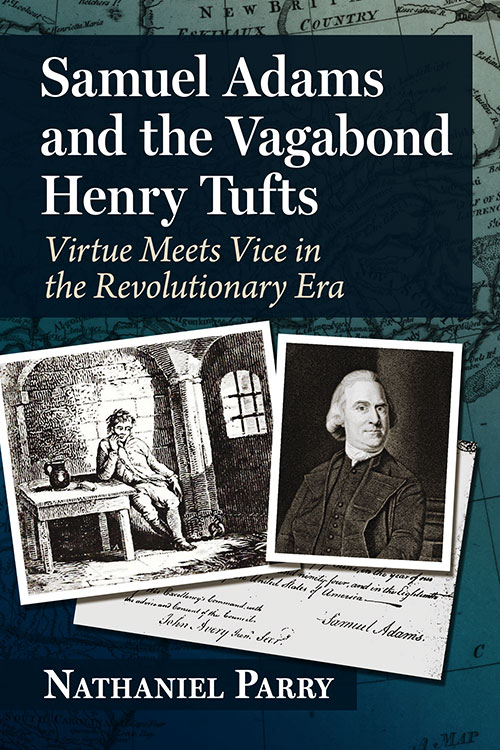
Henry Tufts has often been viewed by his detractors as an aberration, “black sheep of an otherwise respectable family,” as Tufts family genealogist and blogger Thomas Tufts has it. At the same time, Tufts’ contemporaries who championed American independence, “heroes, patriots divine,” as Henry Tufts himself describes them in his book, are lauded as something greater than human. One of these, now best known as the eponymous mascot of a beer company, was Samuel Adams. What two people could be farther apart than an “old Revolutionary patriot” as Edmund Pearson Describes Adams, and a man who is still considered such a disgrace that an article I authored – meant to be titled “In Defense of Henry Tufts” – was ultimately published under the title “Henry Tufts was a villain”?
Author Nathaniel Parry has taken up this question in his book Samuel Adams and the Vagabond Henry Tufts: Virtue Meets Vice in the Revolutionary Era, published by McFarland. The answer is that there’s far less of a distance between the two than you’d think, highlighting the importance of historical perspective, and showing Henry Tufts as a part of his environment rather than anything particularly out of place.
The book follows the careers of both men – Adams, in his early life, then in the days before the Revolution broke out, and his role in the Boston Tea Party, his being specifically considered a fomenter of unrest by loyalists, through to his days as the governor of Massachusetts and his unfortunate slide in his later years to near irrelevance – and Henry Tufts from his humble beginnings in his act of rebellion in stealing his father’s horse, to his life with the Abenaki of Maine, to his career’s great culmination in his death sentence and pardon by Governor Adams in Massachusetts.
The need for comparison between the two men is raised by this incident, the one and only time Adams acknowledged Tufts’ existence. This book was written with a specific goal of considering this particular moment, as it brings the two men into each others’ spheres, showing them as two sides of the same coin – one, a rebel against an imperial system, the other, a rebel against the standards of society itself.
Parry’s book is particularly instructive on the connection between Tufts and Adams, noting for example that Tufts and Adams were distant cousins by marriage. This fact was never acknowledged by either party, but could hint at a familial motive in the pardon. However, the most illuminating is the overall considerations Parry offers of the era itself. The state, and indeed the entire nation, had recently experienced what came to be known as Shays’ rebellion, a popular uprising in Western Massachusetts of war veterans who had risen up against local authorities; and the people involved were largely pardoned by Governor John Hancock in the end, in recognition of their lack of criminal motive. Indeed, writes Parry, capital punishment was becoming scarcer in Henry Tufts’ era, and increasingly frowned upon by Enlightenment thinkers who influenced founders such as Adams. Particularly instructive is a quotation from Adams himself around the same time as his Tufts pardon, stating that incarceration is favorable to “sanguinary punishments.”
That Adams was thinking along these lines, sheds great light on his motivations: Henry Tufts’ story is just a small part of a broader move against capital punishment at the time. And that’s not the only context Parry gives, either. Meticulously detailed are the incidents of unrest, violence, and rebellion of the era, which Adams often encouraged or found himself a part of. We consider also the apparently self-serving motivations of Henry Tufts’ service in the war, signing up for a bounty of land and money. These rewards were offered for the very reason Henry wanted them – for people like Henry, landless and poor, the lofty ideals of liberty were only theoretical. While the likes of Adams propounded these theories, the Henry Tuftses of the world needed more tangible promises to be on board. They did not necessarily lack virtue, but they couldn’t easily afford to be virtuous.
Simultaneously, Parry also considers Henry Tufts and Adams in relation to other spheres of society in their era – the role of women, Native Americans, and their attitudes on slavery. These serve to expand our perspectives on the world in which our story takes place. In each case and overall throughout the book, we receive a graying of the two figures and history itself – Henry becomes not so bad; Samuel Adams and the Patriot cause, more complex, with Parry ultimately calling for us to abandon labels like “heroes” and “villains” in history – everyone fits into a different space.
Edmund Pearson, the counterpart of Parry in the early twentieth century, was not fond of the idea of complicating established narratives, writing, “I detest the iconoclast, the shatterer of myths, the pedant who takes joy in exploding harmless and enjoyable legends,” but I think this is something of a strawman Pearson is excoriating here. What Parry does when he examines the story of Henry Tufts to get to the truth is to find it all more interesting than when we started. Parry starts with an interesting story of a Great Man pardoning a villain, and has found them both to be occupants of their own time, a time I now understand that much better as a result of reading Parry’s book. America, writes Parry in his final line, was founded on “idealism and crime,” which is a remarkable thought embodied by the book’s two central figures. What has been damaged other than our expectations?
The full biography of Henry Tufts has yet to be written; but for anyone wanting a broader perspective on the world occupied by Henry Tufts, Nathaniel Parry has you covered. And you’ll come away understanding Samuel Adams as a figure in history rather than a beer icon as well!
Disclosure: Review copy provided by the author. I was consulted for sources and thoughts, and am included in the acknowledgements as well as cited.
Order here: https://mcfarlandbooks.com/product/Samuel-Adams-and-the-Vagabond-Henry-Tufts/
 Henry Tufts Online