
Having discovered the actual court records of Henry Tufts’ most harrowing run-in with the law, and found Tufts’ Narrative to not be the paragon of truth which its author claims it to be, Edmund Pearson emerges sounding rather disheartened:
What becomes of the sexton, going on August 14th, at 8 A.M., to dig the grave? And the coffin that put the school-mistress in a tremor? And the sympathetic deputy sheriffs? And the three thousand persons of Ipswich, and roundabout, who came to see a hanging, and had to go home in bitter disappointment?
Are we to think that Governor Adams–who was over seventy years old, and should have been past such pranks–was playing a joke on all these people, by failing to let the Sheriff of Essex know that four weeks earlier he had postponed the ceremony until late the next month, and had almost determined to forbid it altogether?1
Thief though he may have been, the reader wants to trust Henry Tufts, even when his claims are absurd. We want his book to be true, especially when it everywhere claims to be so. One need look no further than the preface to find claims of complete fidelity to truth, and those, furthermore to be most reasonable: “the reasons, that heretofore compelled me to secrecy and silence, have ceased to exist ; concealment has become no longer useful, and the suppression of truth unnecessary. I therefore intend, as my only practicable atonement to those I have injured, to give, with truth and sincerity, a faithful relation of the principal occurrences of my life.”2
Perhaps because of these affirmations of truth (though, one might suspect, Henry Tufts doth protest too much), Tufts’ readers can easily make the mistake of trusting his claims. Thomas Wentworth Higginson was a bit cautious, saying “Of course it is easy to say that he lied ; that probability must steadily be kept in view at every page,”3 though he follows this statement up with “but the general atmosphere of a book is unmistakable, and here the coarse verisimilitude is very great.”
“Coarse verisimilitude,” beyond of course the great entertainment value of the book, is what I have most enjoyed about it from the beginning. Whether the recounted incidents in Henry Tufts’ life really occurred or not, the fact that the book exists at all, and makes these claims, at least speaks to a truth of at least one person’s perspective on life in the late colonial period and the early United States.
That said, having had the advantage of reading the work of Edmund Pearson and Thomas Wentworth Higginson—as well as Mary P. Thompson in Landmarks in Ancient Dover, whose prudish sensibilities kept her from reading Henry Tufts’ book, but who still effectively cautions skepticism about the book’s specific claims—I have largely held myself back from credulity, even, occasionally, wondering if I possessed enough evidence to believe the person described in the Narrative had even existed.
One specific claim of the book that I have always thought too unlikely to be at all true
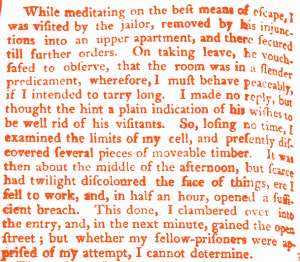
is of Henry Tufts’ escape—for the entire rest of his life, more than thirty years!—from his sentence of life imprisonment, which he claims came about in the following manner: having been confined in the prison at Castle Island in Boston Harbor for several years, eventually he received an unexpected stroke of luck: “the commonwealth of Massachusetts ceded the castle, with its dependencies, to the government of the United States, on which transaction it was predicated, that the removal of the convicts from the island would be a necessary consequence,”4 so that “it was my lot to be carried and shut up, with five or six other of our worthies, in Salem jail,”5 where “[the jailor] vouchsafed to observe, that the room was in a slender predicament, wherefore, I must behave peaceably, if I intended to tarry long.”
Since Henry certainly did not intend to tarry long, this led to his escape: “it was then about the middle of the afternoon, but scarce had twilight discoloured the face of things, ere I fell to work, and, in half an hour, opened a sufficient breach. This done, I clambered over into the entry, and, in the next minute, gained the open street.”
According to the book, after this, Henry Tufts was never imprisoned again. “Since that period I have carried my dish pretty uprightly ; have been guilty of few or no misdemeanors, but have persevered heroically in regular habits and virtuous resolutions.”6 He even claims, in the preface, that “I no longer dread the scourge of future punishment”!7 And this from a man who is ostensibly writing as a fugitive from a life sentence!
There does not seem to be much truth, or, in fact, even, “coarse verisimilitude” in this claim. For this to be true, one would have to accept that a man could escape from life imprisonment, and publicly advertise the fact later, under his own name, without any repercussions whatsoever.
Yet this, it turns out, is exactly what happened. While previous generations of researchers have struggled to find any primary sources to corroborate Tufts’ claims—with Pearson finding only a single mention in a newspaper8—internet-aided primary source research has allowed me to uncover the truth of this claim.9
An article from the Salem Gazette—in fact the same paper in which Pearson found his only example of Henry Tufts in the news—dated November 20, 1798, reads, in full:
Broke Jail, in Salem,
On the night of the 10th inst. the following persons, being Convicts from Castle Island, viz. HENRY TUFTS, 5 feet 10 inches high, 53 years old, and of a light complexion; JAMES HALLYWELL, 5 feet 6 inches, 25 years old, marked B on each cheek; MILES RILEY, 5 feet 8 inches, 25 years old, light complexion, and squint-eyed; WILLIAM BROWN, 5 feet 9 inches, 35 years old, dark complexion.
A reward of Five Dollars will be paid, for each of any of the above named Criminals, whom any person may secure in either of the jails in this Commonwealth.
JOSEPH TURELL, Jailor.10
All of the salient details are here, minus the narrative flair of the book: The jail being in Salem; The convicts being from Castle Island; and, most importantly, Henry Tufts being among the escaped.
Furthermore, no record exists in any paper of Tufts ever being arrested ever again. Apparently, the five dollar reward offered by Joseph Turell was never collected.11
The story as told by Henry Tufts himself, however, is borne out. Years later, in 1821, even after the book was published (and frankly admitting Tufts to be a resident of “L[i]mington, in the district of Maine,”12) an article in the Newburyport Herald, of Massachusetts, discussing the death penalty, writes “Henry Tufts was convicted of burglary, and sentenced to suffer capitally, but his punishment was commuted to imprisonment for life at castle William, in Boston harbor, from which he afterwards escaped.”13
So Henry Tufts really did live out the rest of his life in peace. And when he died—confirming his statement that “I still budge about, as a travelling physician”14—he was recorded in the paper as “Dr[.] Henry Tufts.”15
What are we to make, then, of the Salem jailor, now known to be Joseph Turell, and his unpaid five dollar reward? Are we to really believe that he invited Henry Tufts to escape from the Salem jail? What of all the countless people who knew that Henry Tufts had escaped, as well as where he lived? Was justice so easily avoided in that time and place?
I have no easy answers, but I have evidence. A seeming lie has been unmasked as truth.
—Daniel Allie

Endnotes
1 Pearson, Edmund. “The Six Silver Spoons.” HenryTufts.com, 2017. Web. 9.
2Tufts Henry. The Narrative of Henry Tufts. Charleston: CreateSpace, 2017, 10.
3Higginson, Thomas Wentworth. “A New England Vagabond.” HenryTufts.com, 2017. Web. 14.
4Tufts, Narrative, 246.
5247.
6279.
79.
8“At last, one day, after a dozen failures, I opened the pages of the Salem Gazette, and found the record of his conviction,– probably the first time that Henry Tufts ever got his name in the papers.” “The Six Silver Spoons,” 9.
9Many thanks to Thomas W. Tufts of tuftsgenealogy.blogspot.com for bringing the following evidence to my attention.
10“Broke Jail, in Salem.” Salem Gazette, Vol. XII, Iss. 761, Pg. 4 (November 20, 1798). GenealogyBank. Web. Accessed 15 August 2017.
11Nor have I found any confirmation that the three other “worthies” were ever captured again, either.
12Tufts, Narrative, 1.
13“Since our revolution. . . “ Newburyport Herald, Vol. XXIV, Iss. 97, Pg. 3 (March 6, 1821). GenealogyBank. Web. Accessed 15 August 2017.
14Tufts, Narrative, 279.
15“Deaths.” Eastern Argus, Vol. XXVII, Iss. 1462, Pg. 3 (February 22, 1831). GenealogyBank. Web. Accessed 15 August 2017.
 Henry Tufts Online